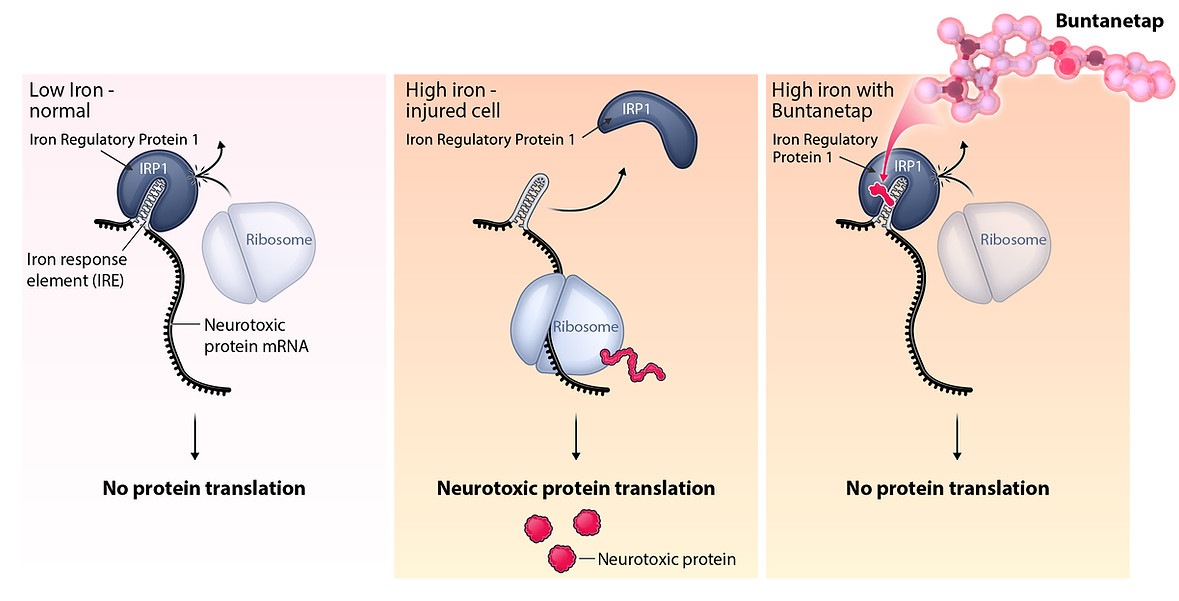
Buntanetap, and where noted, buntanetap and/or ANVS405, reduced multiple neurotoxic proteins and therefore, rescued neuronal health and restored animals’ normal functions.
Lowered levels of neurotoxic proteins (ANIMAL):
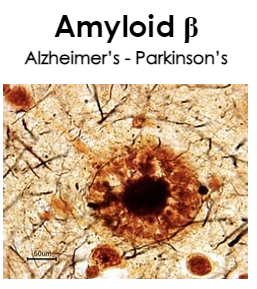
- AD mice – lowered levels of APP and improved its fragments with full recovery of memory, learning and brain function [Teich at al. 2018]
- DS trisomic mice – lowered levels of APP and recovered memory and learning [Chen et al. 2020]
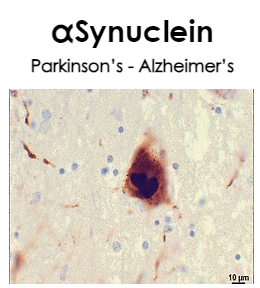
- PD mice – lowered levels of αSYN in brain and gut and regulated gut motility [Kuo et al. 2019]
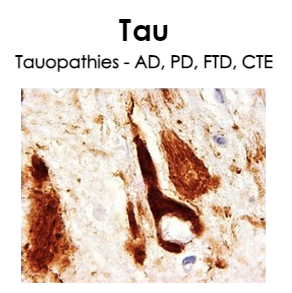
- MCI patients – lowered levels of APP, tau and αSYN [Maccecchini et al. 2012]
Improved retrograde and anterograde axonal transport (ANIMAL):
- DS trisomic mice fully differentiated nerve cells – buntanetap treatment increased velocity by 70% and decreased pause time by 29% [Chen et al. 2020]
Increased synaptic transmission in (ANIMAL):
- AD mice – had similar long-term potentiation as healthy, wild-type mice after treatment with buntanetap [Teich et al. 2018]
Increased neurotransmitter release in (ANIMAL):
- TBI rats – after traumatic brain injury, ANVS405 restored dopamine levels in the striatum [Chesselet UCLA, submitted for publication]
Increased levels of neurogenesis and BDNF in (ANIMAL):
- AD mice brains [Lijia et al. 2013]
Buntanetap and ANVS405 lowered inflammation in (MCI HUMANS and ANIMAL):
- MCI humans – in CSF of MCI patients, inflammatory markers were reduced [Maccecchini et al. 2012]
- TBI rats – in the brains of treated rats the microglia were not activated showing that there was no inflammation after TBI [Chesselet UCLA, in preparation]
ANVS405 protected nerve cells in (ANIMAL):
- TBI rats – staining in the substantia nigra for dead cells, showed that treated rats had similar stain signal to non-TBI rats. [Chesselet UCLA, submitted for publication]
- Retina of rats with acute glaucoma – ANVS405 protected 67% the retina [Sundstrom, Hershey Medical, unpublished]
In summary buntanetap improves or restores the affect function in seven different animal models:
In four models of memory and learning: AD mice [Teich at al. 2018]; Down syndrome mice [Chen et al. 2020]; stroke mice [Turcato et al 2018]; traumatic brain injury rats [Chesselet UCLA, submitted for publication]
In two models of movement disorder: PD mice [Kuo et al. 2019] and in FTD mice.
Finally, it protects the retina and eyesight in acute glaucoma rats.
.webp)








.svg)


.svg)
.svg)
.svg)
