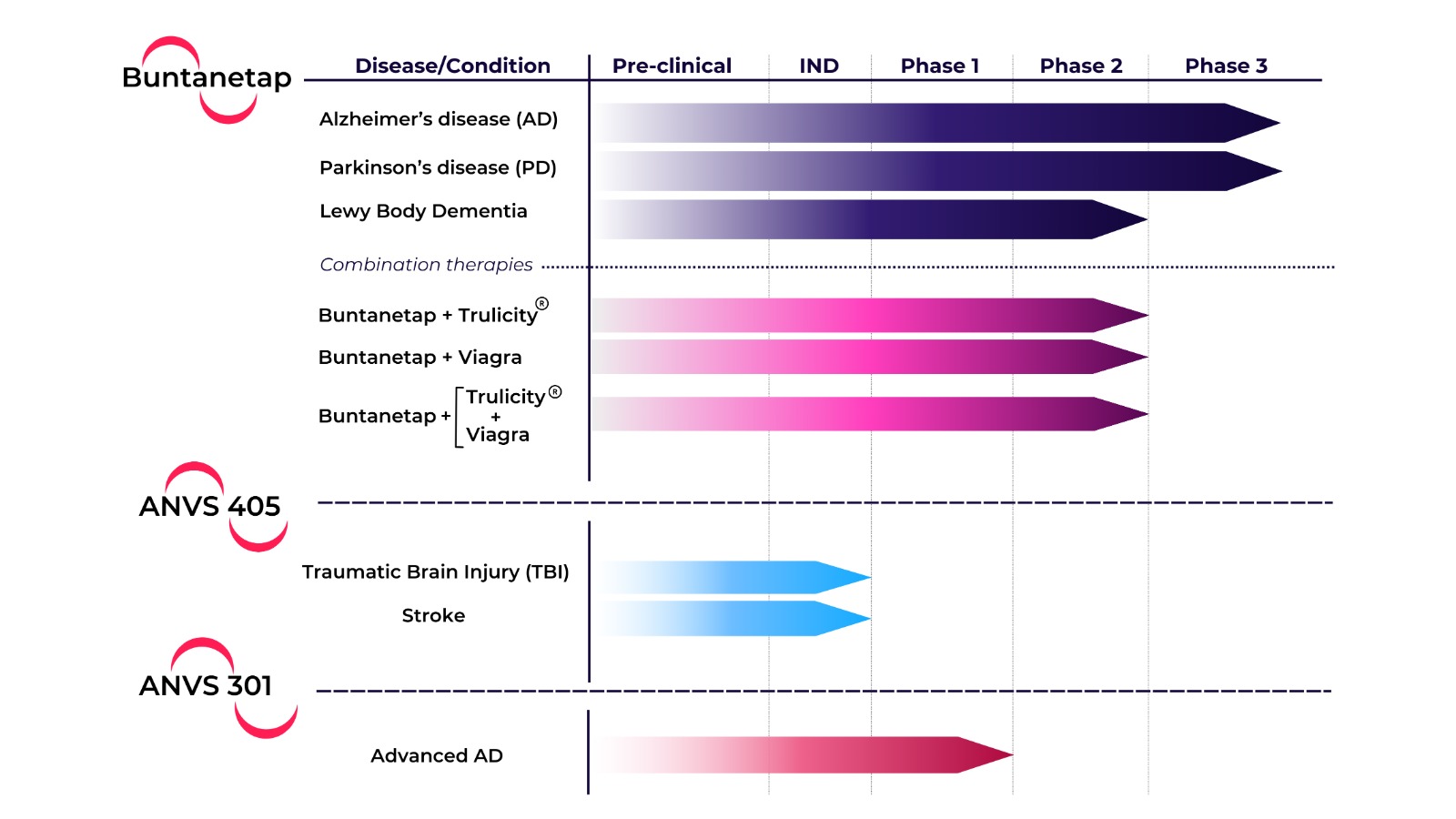
Our Pipeline consists of drugs for chronic neurodegeneration – Alzheimer’s disease (AD), Parkinson’s disease (PD) and other neurodegenerative conditions. Additionally, we have a compound to treat acute neurodegeneration – traumatic brain injury (TBI) and stroke – and a third compound for advanced AD.
Buntanetap is our lead compound, currently in a Phase 3 clinical trial for Parkinson’s Disease and Phase 2/3 for Alzheimer’s Disease.
ANVS405 is being developed for acute indications, focused on protecting the brain after TBI and/or stroke. ANVS405 is the same compound as buntanetap, but it is given intravenously in cases of acute head and brain trauma.
ANVS301 is expected to increase cognitive capability in later stages of AD and dementia.
COMPLETED PHASE 3 STUDIES
Parkinson’s Study
We conducted a Phase 3 study in early Parkinson’s patients, with a total of 471 patients completed the trial in the US and EU. The last dosing was completed in December 2023. The results were announced in July 2024, showing that buntanetap improved cognition in all PD patients and improved MDS-UPDRS Part II, Part III, Part II+III and Total scores in patients with a >3-year diagnosis as well as in patients with Postural Instability and Gait Difficulties (PIGD).
Alzheimer’s Study
The Phase 2/3 in mild to moderate Alzheimer’s patients was completed in February 2024 with a total 325 patients completed the study in the US only. The top line data was announced in April 2024 showing significant cognitive improvements in the subpopulation of mild AD.
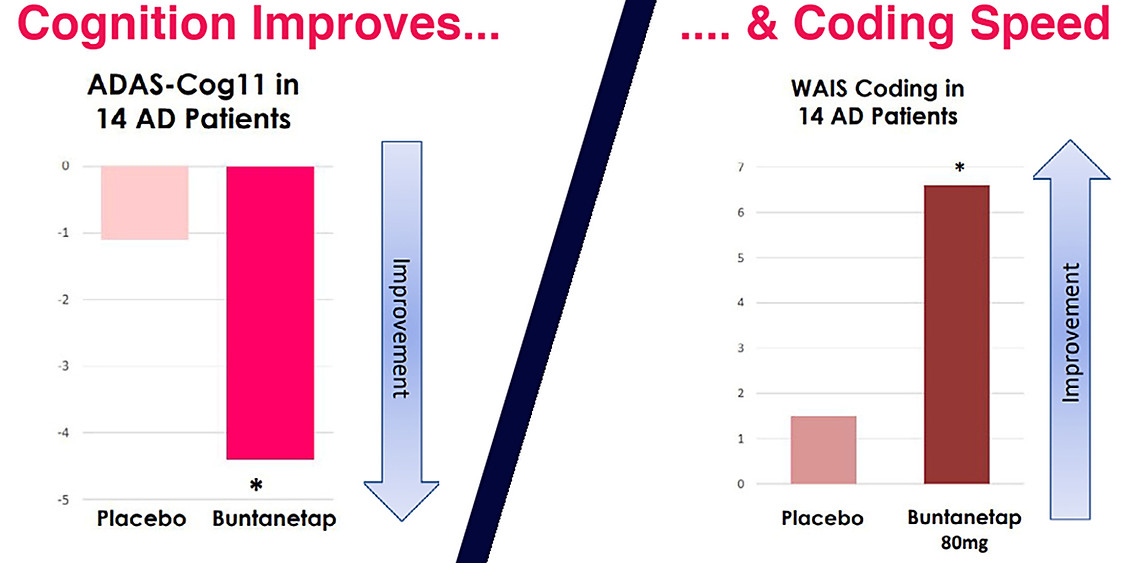
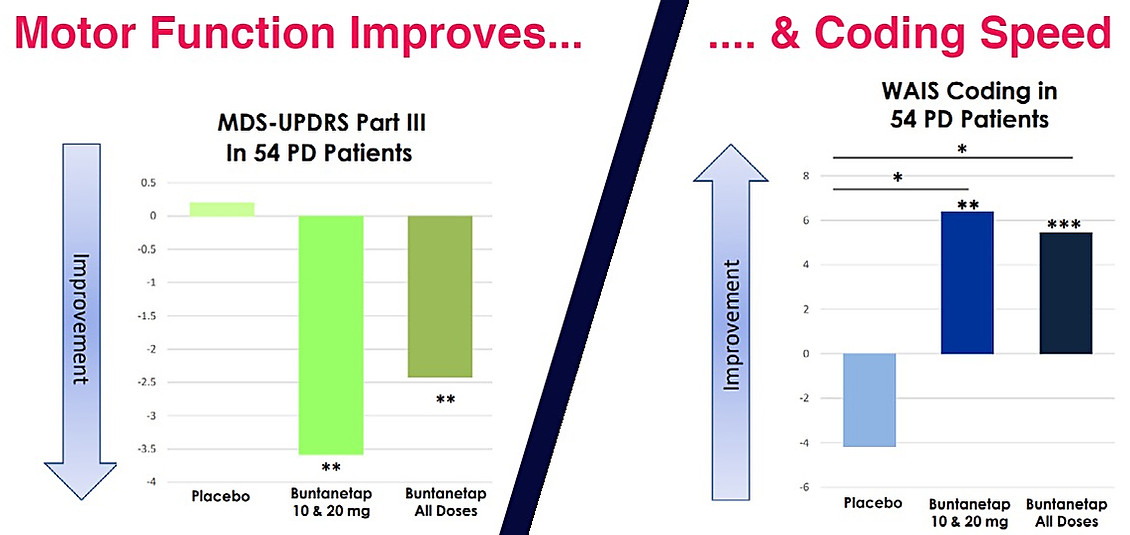
In 2020, we began treating a total of 68 AD and PD patients for one month with descending doses of buntanetap. We treated 14 AD patients randomized to 80mg or placebo once per day (QD) and 54 PD patients who were randomized to 0, 5, 10, 20, 40 and 80mg QD of buntanetap.
In both populations, we measured levels of specific biomarkers in plasma and cerebrospinal fluid (CSF) known to contribute to the toxic cascade that leads to nerve cell death, along with clinical functional and cognitive measures.
IN AD PATIENTS - IMPROVED COGNITION BY ADAS-Cog11 AND IMPROVED SPEED AND ACCURACY BY WAIS CODING TEST
The data from the 14 AD patients show that from baseline to 25 days in the buntanetap-treated group, ADAS-Cog11 improved by 4.4 points, a statistically significant improvement of 30% (p<0.05). Compared to placebo at 25 days the treated group is 3.3 points better than the placebo. The WAIS coding test measures speed in movement and thinking. Treated AD patients show a statistically significant 23% improvement compared to baseline.
IN PD PATIENTS – IMPROVED MOVEMENT BY MDS-UPDRS AND IMPROVED SPEED AND ACCURACY BY WAIS CODING TEST
All buntanetap treatment groups combined showed statistically significant improvement in the MDS-UPDRS Part III and WAIS coding test. 10 and 20mg groups are the best performing groups. (* P<0.05; ** P<0.01; *** P<0.001).
PROOF OF CONCEPT STUDY IN MILD COGNITIVE IMPAIRMENT (MCI) PATIENTS
In the human POC study, four patients with MCI were treated for 10 days with buntanetap with the safe dose of 4x60mg (240mg/day). CSF and plasma were drawn over 12 hours on day 0 and day 11.
Buntanetap lowered levels of neurotoxic proteins, APP, tau and αSYN with statistical significance in all four patients. The levels of neurotoxic proteins decreased to levels found in healthy, normal volunteers.
Safety was evaluated in all three studies and buntanetap pattern of adverse events (AEs) was similar to that seen in typical studies in healthy normal volunteers, with an overall incidence rate of 33.3% among placebo-treated subjects and 35% for all buntanetap treatment groups combined. In the single ascending dose study, the 160mg/day group - the highest dose group in the study – had a treatment-related AE rate of 31.7%. In the multiple ascending and in the POC study there were no dose-related AEs. Most AEs were of short duration, mild or moderate in severity, and resolved without medical intervention. These data were* reported to the FDA in SN 0016 and SN 0018.
Clean safety profile up to 160mg, which is a dose that is expected to be about 10 times higher than the efficacious dose.
Buntanetap, and where noted, buntanetap and/or ANVS405, reduced multiple neurotoxic proteins and therefore, rescued neuronal health and restored animals’ normal functions.
Lowered levels of neurotoxic proteins (ANIMAL):
AD mice – lowered levels of APP and improved its fragments with full recovery of memory, learning and brain function [Teich at al. 2018]
DS trisomic mice – lowered levels of APP and recovered memory and learning [Chen et al. 2020]
PD mice – lowered levels of αSYN in brain and gut and regulated gut motility [Kuo et al. 2019]
MCI patients – lowered levels of APP, tau and αSYN [Maccecchini et al. 2012]
Improved retrograde and anterograde axonal transport (ANIMAL):
DS trisomic mice fully differentiated nerve cells – buntanetap treatment increased velocity by 70% and decreased pause time by 29% [Chen et al. 2020]
Increased synaptic transmission in (ANIMAL):
AD mice – had similar long-term potentiation as healthy, wild-type mice after treatment with buntanetap [Teich et al. 2018]
Increased neurotransmitter release in (ANIMAL):
TBI rats – after traumatic brain injury, ANVS405 restored dopamine levels in the striatum [Chesselet UCLA, submitted for publication]
Increased levels of neurogenesis and BDNF in (ANIMAL):
AD mice brains [Lijia et al. 2013]
Buntanetap and ANVS405 lowered inflammation in (MCI HUMANS and ANIMAL):
MCI humans – in CSF of MCI patients, inflammatory markers were reduced [Maccecchini et al. 2012]
TBI rats – in the brains of treated rats the microglia were not activated showing that there was no inflammation after TBI [Chesselet UCLA, in preparation]
ANVS405 protected nerve cells in (ANIMAL):
TBI rats – staining in the substantia nigra for dead cells, showed that treated rats had similar stain signal to non-TBI rats. [Chesselet UCLA, submitted for publication]
Retina of rats with acute glaucoma – ANVS405 protected 67% the retina [Sundstrom, Hershey Medical, unpublished]
In summary buntanetap improves or restores the affect function in seven different animal models:
In four models of memory and learning: AD mice [Teich at al. 2018]; Down syndrome mice [Chen et al. 2020]; stroke mice [Turcato et al 2018]; traumatic brain injury rats [Chesselet UCLA, submitted for publication]
In two models of movement disorder: PD mice [Kuo et al. 2019] and in FTD mice.
Finally, it protects the retina and eyesight in acute glaucoma rats.
Neurotoxic Proteins Impair Axonal Transport and Cause a TOXIC CASCADE
High levels of neurotoxic proteins create a toxic cascade leading to faulty nerve cell functioning
Buntanetap Improves Axonal Transport and IMPEDES THE TOXIC CASCADE
Lowering levels of neurotoxic proteins impedes the cascade-effect of neurodegeneration. Buntanetap...
Stay Updated with Annovis Bio, Inc. (NYSE: ANVS)
Join the Annovis Bio Newsletter to receive the latest updates on our groundbreaking research and developments in neurodegenerative diseases like Alzheimer's and Parkinson's
Thank you for subscribing
Oops! Something went wrong while submitting the form.
.webp)







.svg)


.svg)
.svg)
.svg)
